Permaculture farming
How a farm becomes a complete biological unit — soil, plants, animals + vater and the economics of working with nature.
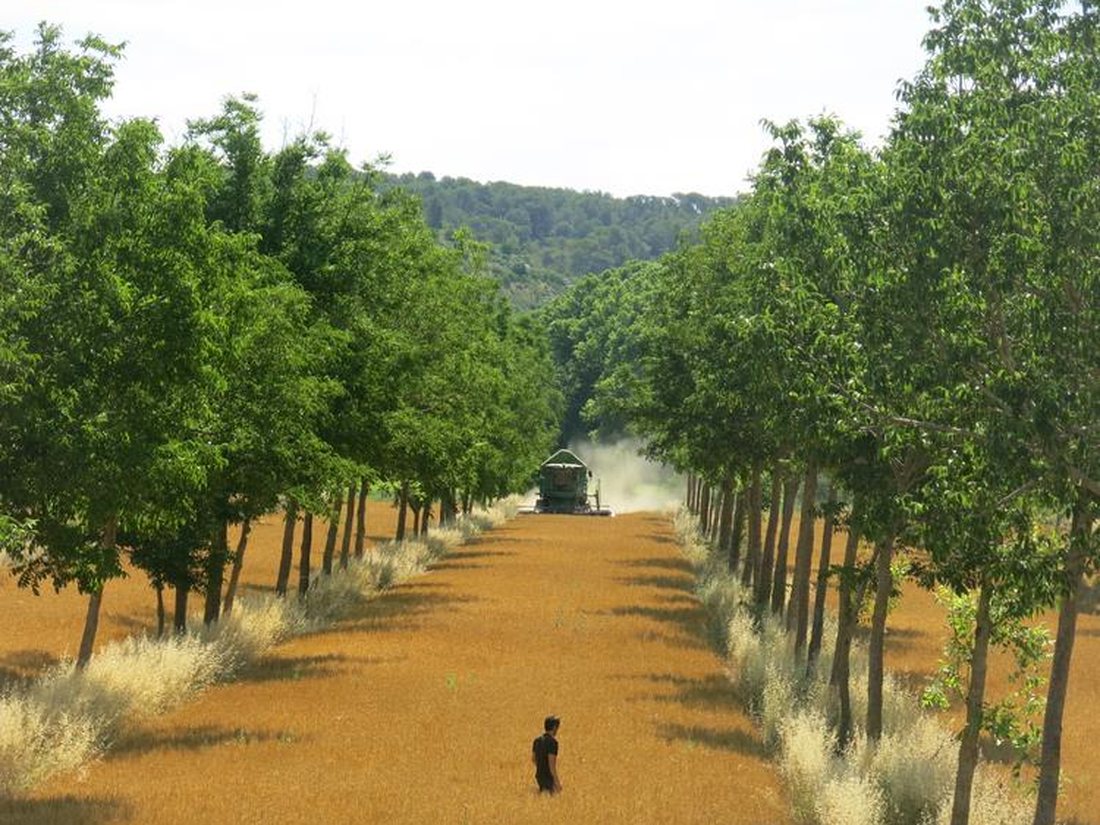
A permaculture farm is not a set of techniques bolted onto a conventional holding. It is one or more complete biological units, where plants and animals are placed so that they support each other's needs. The farmer's work is to restore nature's biological cycle and keep it running; water, belts, animals and yields follow.
Working with nature
Permaculture farming works with nature, never against it. In practice that means rebuilding the biological cycle until the soil food web is re-established. Plants and animals are not separate enterprises but elements of one cycle, designed for as many symbiotic effects as possible. A permaculture farm is regenerative organic farming, and all biological material on it is used the way nature uses it.
First comes a design plan; then the soil work that gives your crops the soil food web they need.
Rain is the first design decision
Of all the decisions in a design plan for a regenerative farm, collecting and using rainfall is the most important. Rain is not something to be drained away: it is energy, part of the hydrological cycle that carries nutrition, energy and biology across the farm.
So all rainwater drains are stopped. Water is distributed across the land instead of leaving it, and overflow is managed in productive lakes and ponds for later irrigation. A farm that sheds its water sheds its fertility.
Perennial belts and the forest effect
In the fields, use as many perennial plants as you can: herbs, grass, clover. A wide belt of soil-building pioneer plants comes first, followed by food-producing trees, shrubs and other useful plants. The belts can run around buildings and fields, and a single field, a lake edge, a river bank or a barren hilltop is enough to start.
The purpose is the forest effect. Plant succession, driven by the pioneers, must reach from belt to belt, across the fields, until the soil microbial food chain is restored over the whole farm, not only under the trees. It then becomes a breeding ground for food-producing trees, shrubs, herbs and mushrooms that grow and produce by themselves for many years.
Nine layers, and chop and drop
The belts are grown in up to nine layers, as in a natural forest, each occupying a different height and root depth so the ground stays covered while the trees mature.
Chop and drop does the fertility work: the pioneers are cut and dropped where they grow, or where the material does the most good, and soil biology breaks it down in place. That builds a substantial forest effect quickly, without importing fertility.
Soil that is never bare
There must be live plants and organic matter on the fields all year round. The organic matter should cover the entire surface of the ground, so that the soil never sits in direct sunlight.
Animals and the microbiology of manure
Different animals should have direct or indirect access to the land every year, preferably several times. Fresh ruminant manure matters most: the microorganisms in a ruminant's stomach are vital for building and maintaining soil microbiology, and cow manure is part of the biology that builds and maintains beneficial insects and nature.
Zones 0 to 5
A permaculture project is divided into zones by how often it needs attention. Large farms often have all six.
- Zone 0: the house and buildings.
- Zone 1: several visits a day — greenhouse, layers, small dams, aquaculture.
- Zone 2: a daily visit — compost, poultry for slaughter, large dams, herbs.
- Zone 3: several visits a week — animals, fish, bees, berries, vegetables.
- Zone 4: a weekly visit in the growing season — fields with crops, food-producing fences, orchards.
- Zone 5: supervision once a year — often close to original nature: steep slopes, meadow or forest for grazing.
Zones 1, 2 and 3 are often vegetable production, perhaps under glass, with fish and vegetables together, fruit and berries, and pigs, chickens and other small animals that fit the cycle. On large western farms with hundreds of cows or thousands of pigs, zones 4 and 5 take more room, for grazing, winter fodder and fodder grain. Getting such biologically dead land to function again needs the forest effect across every area in development. Well-tested biological methods can do it in a few years, but it takes a complete resetting of the farm.
How permaculture farming differs
Agriculture can be degenerative, generative or regenerative. Chemical farming, as practised in Denmark and most of the western world, is degenerative in almost every conceivable context: large amounts of unnatural products, ploughing almost every year, monoculture.
Organic farming usually drops many of those products but keeps the plough and the monoculture, so much of it is still degenerative. A few organic farms, often small, are generative; regenerative organic farms in the western style are very few.
Biodynamic farming is sometimes largely regenerative, often only generative where fields are sown and ploughed every year, and degenerative where annual monocultures grow on a ploughed field.
Permaculture farming is regenerative once the design and its implementation are completed. Every design plan aims to get there as fast as possible, and many places do.
Two to three years, then five to ten
New biological technologies and methods make it possible to recover a large part of the regenerative power in only two to three years. The full natural regenerative power takes five to ten years to establish, and then operates by itself.
The problem is the solution
On most western farms slurry is a problem: it has a negative biological effect on the soil food chain. It is not impossible to make it work. "The problem is the solution" is one of the fundamental ideas of permaculture, and slurry is a good place to apply it.
Size is not the obstacle. Farms of 50, 100, 500 or 1,000 hectares, or much larger, can be based on permaculture and obtain a much higher production. The largest ready-made permaculture project is 35,000 square kilometres in China, where hundreds of thousands of small farms were converted at once and production tripled in a few years, still rising. In Australia and the United States, farms of thousands of hectares run dairy cows, pigs, poultry and other livestock on permaculture methods, once their soil food chain was restored. It can be done all over the world.
Starting
If you want to know what your farm could look like as one biological unit, start with the design plan: water first, then the belts, then the soil biology that makes the rest possible. Book a design plan.
Continue reading
All guides
The permaculture garden
Make zones and water : how a garden becomes a working biological cycle that keeps producing for decades.
Read the guide
The smallholding
Three to five hectares, several small cycles and a family income: what a permaculture smallholding can realistically do.
Read the guide
What is permaculture?
A working definition of permaculture: a food-productive copy of nature's biological cycle, built from soil, plants and animals.
Read the guide